You booked a glamorous camping stay, and now you’re staring at an empty duffel wondering what on earth to bring. The bed is sorted, the kitchen is stocked and the tent (or dome, or treehouse) is already standing, so glamping trip packing feels strangely confusing. Do you still need a headlamp? What about towels, chargers or a rain layer? The good news is that packing light is actually the whole point of glamping, since most sites limit luggage space anyway, making one duffel plus one daypack the practical maximum.
This checklist walks you through exactly what to bring and what to leave behind. We’ll start by matching your list to the season, then cover clothing layers, toiletries, gear worth the space, and the documents and booking details to have handy. There’s also a section on packing for special stays like domes, treehouses and desert camps, followed by a wrap-up checklist you can screenshot before your next luxury tent adventure.
Before You Pack: Match Your Glamping Trip Packing List to the Season
Before anything goes into your duffel, look up the night-time lows for your destination in your travel month. Daytime forecasts can be misleading: desert and mountain glamping sites often drop below 10°C (50°F) after sunset, even in the height of summer. That warm afternoon photo on the listing tells you almost nothing about how cold your tent will feel at 3 a.m.
The season shapes your list more than anything else. For the June-September peak season, which applies to most Northern Hemisphere destinations, lighter layers usually do the job, with one warm option for evenings. Shoulder-season stays in spring and autumn are a different story: overnight temperature swings of 5-15°C (41-59°F) are common, so insulated sleepwear and a warmer sleeping setup become genuinely useful rather than optional.
Ask the host before you pack thermals
Heating, air conditioning and hot water vary enormously between sites, and at $150 to $600 per night you should not have to guess. Some luxury tents come with wood stoves and heated blankets; others rely on a basic fan. Message your host before packing and confirm exactly what is provided, then decide whether you need extra thermals, a hot water bottle or simply a lighter set of sleepwear. Five minutes of asking saves you from shivering through a stay that looked cozy online.
Clothing Layers: The Core of Any Glamping Trip Packing Checklist
Glamping might promise hotel-level comfort, but the walk from your car to the tent, the evening spent on the deck and the sunrise coffee run all happen outdoors. That’s why clothing is the backbone of any glamping trip packing checklist. A three-layer system keeps you comfortable through the 5-15°C (41-59°F) overnight swings that are common in spring and autumn: start with a moisture-wicking base layer, add an insulating mid-layer such as a fleece or light sweater, and finish with a rain shell. That shell is non-negotiable if your destination gets more than 3 inches of rainfall in a month, which is true for many forest and lakeside sites.
Footwear deserves more thought than most first-timers give it. Bring two pairs of broken-in walking shoes or hiking boots so a soaked or muddy pair never ruins your day, plus a set of camp sandals for relaxed evenings on the deck. And because safari tents and glamping decks rarely give you much control over shade, pack one warm hat for chilly mornings and one sun hat for midday.
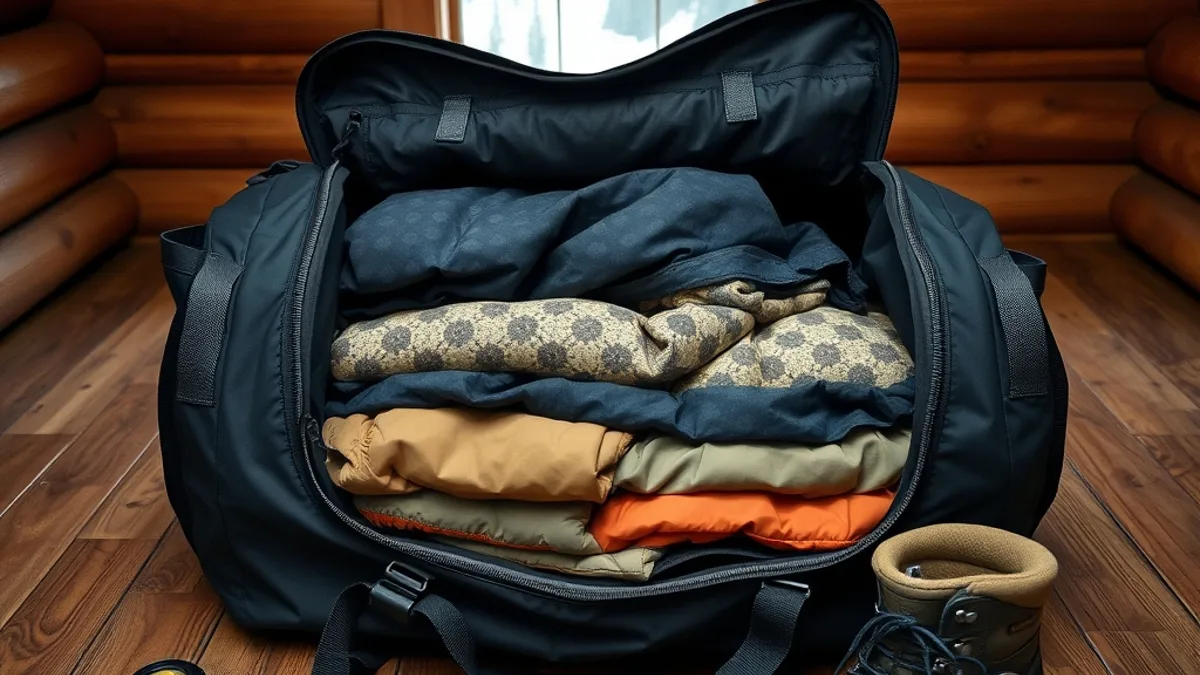
Finally, resist the urge to overpack. Most glamping sites have limited luggage space, so one duffel plus a daypack is the practical maximum. Here’s how to make those layers work harder:
- Choose merino or synthetic base layers over cotton. Cotton stays damp for hours after a sweaty hike or morning dew, while merino and synthetics dry quickly and resist odor over a multi-day stay.
- Pick a mid-layer that zips. A zip fleece lets you fine-tune your temperature on the deck without swapping layers entirely, which matters when evenings cool down fast after a warm afternoon.
- Test your rain shell for packability. A shell that folds into its own pocket stashes easily in your daypack, so you’re covered on impromptu walks even when the forecast looks clear at breakfast.
- Stick to dark or earth-tone colors. Mud, campfire smoke and grass stains are part of the experience, and darker fabrics hide them far better than white or pastel pieces.
- Wear your bulkiest layers in transit. Boots, mid-layer and warm hat worn on travel days free up serious duffel space for everything else on this checklist.
Toiletries and Personal Care for a Luxury Tent Stay
Tent bathrooms are charming but tiny. Most safari tents, yurts and domes offer a washbasin and a shelf the size of a paperback, so full-size bottles quickly become clutter. Choose solid toiletries instead: shampoo bars, conditioner bars and soap last longer than liquid versions, won’t leak in transit, and take up almost no counter space. If you prefer liquids, decant them into travel-size containers under 100 ml so they fit carry-on rules as well as your washbag.
Sunscreen deserves a spot of its own. Pick a reef-safe formula in a travel-size tube, especially if your site is near a lake, river or coast where you’ll be swimming. Solid sunscreen sticks are a smart alternative: they fit in a pocket, don’t count against liquid limits, and make reapplying on the go far easier than squeezing a tube with sandy hands.
Season matters here, too. During the June-September peak season, sites in jungle, lakeside and forest settings can be buzzing with insects, particularly at dawn and dusk. Pack insect repellent and an after-bite treatment so a few itchy welts don’t spoil a $150-600 a night stay. In dry desert and high-altitude locations, flip the priority: lip balm with SPF and a heavy moisturiser will do more for your comfort than any bug spray.
- Biodegradable soap and shampoo bars — a good choice for sites with composting toilets or greywater systems, where harsh chemicals can affect the ground.
- Quick-dry microfiber towel — many glamping hosts provide linens but not pool or lake towels, and microfiber versions pack down to the size of a fist.
- Travel-size wet wipes and hand sanitizer — useful for long drives to remote sites and for freshening up between the tent and a shared washhouse.
- Contact lens supplies plus a pair of backup glasses — dim tent lighting and windy decks make inserting lenses fiddly, and you don’t want to be stuck without an alternative.
- Menstrual products in a small zip pouch — remote sites may have no shop on hand, so bring your usual supplies plus a spare.
Gear and Gadgets Worth the Space
Glamping gets you close to nature without roughing it, but most tents, domes and safari-style structures still run on limited power. Outlets inside your accommodation are often limited to a single socket, and that one plug may be shared between a lamp, a fan and your phone. A power bank in the 10,000-20,000 mAh range lets you charge phones, cameras or a headlamp overnight without fighting over the wall socket. Charge it fully before you leave home, since you may not get a reliable top-up until morning.
After dark, most glamping sites keep paths deliberately unlit to preserve the atmosphere and avoid disturbing wildlife. Walking from your tent to the bathroom block in pitch darkness with a phone flashlight in one hand is awkward and unsafe on gravel or wooden walkways. A headlamp per person solves this, and one with a red-light mode is even better: red light preserves your night vision and is less likely to annoy neighbors in nearby tents.
Think about how you will spend your days, too. Many glamping sites sit at the trailhead of hiking routes, lakes or viewpoints, so a compact daypack and a reusable water bottle earn their space quickly. The daypack also doubles as your carry-all for drives, boat trips or a morning at the site cafe.
- Power bank, 10,000-20,000 mAh: choose one with at least two USB outputs so you can charge a phone and a camera at the same time, and bring the charging cable for it.
- Headlamp with red-light mode: pack one per person, not one per tent, since couples and families often head in different directions after dark.
- Reusable water bottle: an insulated one keeps water cool in hot tents and hot drinks warm on cold mornings on the deck.
- Compact daypack: a packable model that folds into its own pocket takes up almost no room in your duffel until you need it.
One warning before you add anything else: do not pack cooking gear, bedding or towels on the assumption you will need them. Most glamping rates include proper beds with linens, and many include kitchen access or meals, but what is provided varies by rate tier and structure type. A quick message to your host before you pack can save you half a duffel of unnecessary gear.
Documents, Money and Booking Details
Glamping sites are often in remote spots where phone signal fades the moment you turn off the main road. Before you leave home, save offline copies of everything you would need if your data connection disappeared: your booking confirmation, the host’s contact number, and directions to the site. A screenshot folder on your phone works well, but a paper backup is even better for sites with patchy Wi-Fi and no signal at the gate.
Timing matters as much as preparation. For summer dates in the June-September peak season, book your stay 3-6 months ahead, since the best tents and domes at popular sites fill quickly. Once booked, carry a printed copy of your payment confirmation. Some remote hosts check guests in from a farmhouse or office with unreliable internet, and a paper record settles any confusion on the spot.
Finally, reread your booking terms before you pack for shoulder-season dates. Check the host’s cancellation window and their weather policy, so you know your options if a storm rolls in. A few practical items to organize before departure:
- Offline maps: Download the route to the site in a maps app, since rural glamping locations often sit beyond the reach of turn-by-turn directions.
- Host emergency contact: Save a number that works without internet, such as a mobile line, in case you arrive late and the check-in office is closed.
- ID and payment card: Many hosts verify the booker’s identity at check-in, and remote sites may not accept card payments on arrival, so confirm payment methods in advance.
- Booking terms screenshot: Capture the cancellation window and weather policy in one image, so you can reference them quickly if plans change mid-trip.
Packing for Special Glamping Styles: Domes, Treehouses and Desert Camps
Not all glamping sites are created equal, and a few structure types deserve their own tweaks to the standard checklist. Desert camps, treehouse stays and tropical overwater tents each come with conditions that a generic list won’t fully cover, so adjust before you zip the duffel shut.
Desert camps are all about sun and sand. Daytime exposure is intense with almost no natural shade, so treat sun protection as gear, not an afterthought. Wind-blown sand is the other challenge: it gets into everything, from zippers to camera lenses, and a simple buff does more work here than any single clothing item.
Treehouses and forest domes sit up in the canopy, where air stays cool and damp even when the forecast looks mild. A light packable down jacket earns its space at these sites, especially for evenings on the deck or early mornings when mist hangs around until mid-morning. Choose one that compresses small so it doesn’t eat your luggage allowance.
For overwater or tropical glamping, rethink footwear and fabric entirely. Hiking boots are dead weight on a wooden walkway over a lagoon, and cotton clothing never fully dries in humid air. Swap both out and you’ll be far more comfortable.
- Buff or multifunctional scarf: Doubles as sand protection, sun coverage for your neck and a dust mask when desert winds pick up in the afternoon.
- Sealed bags or dry sacks: Keep fine desert sand out of electronics and spare clothing, which a regular zip pocket won’t manage.
- Light packable down jacket: Canopy sites stay cool and damp after sunset, and this layer packs smaller than a fleece while insulating better.
- Reef shoes: Protect feet from coral, hot decking and sharp shells when swimming or wading from overwater platforms.
- Quick-dry clothing: Synthetic or merino pieces handle tropical humidity far better than cotton, which can stay damp for a full day.
Your Glamping Trip Packing Checklist, Wrapped Up
So, what do you actually pack for a glamping stay when the bedding, kitchen gear and shelter are already sorted? The answer is less than you think. A practical glamping trip packing list comes down to layers, solid toiletries, one power bank and one duffel. Your host covers the big-ticket items, so your job is simply to dress for the 5-15°C overnight swings and keep your footprint small.
Match your list to the season and site type, from desert camps to forest domes, and you will be comfortable in any structure your budget books. With bedding and kitchen gear handled by the host, smart packing keeps your stay luxurious and light. Got a packing tip of your own, or a question about an upcoming trip? Leave a comment below or share this article with a fellow traveler.